
MoE Guide
ForeBlocks integrates Mixture-of-Experts into the transformer feedforward path through MoEFeedForwardDMoE.
You typically do not instantiate this block directly. Instead, you enable MoE through transformer constructor arguments or the FeedForwardBlock module.
Related docs:
- Documentation Overview
- Getting Started
- Transformer
- Custom Blocks
- Advanced MoE — routers, load-balancing, expert types, production tuning
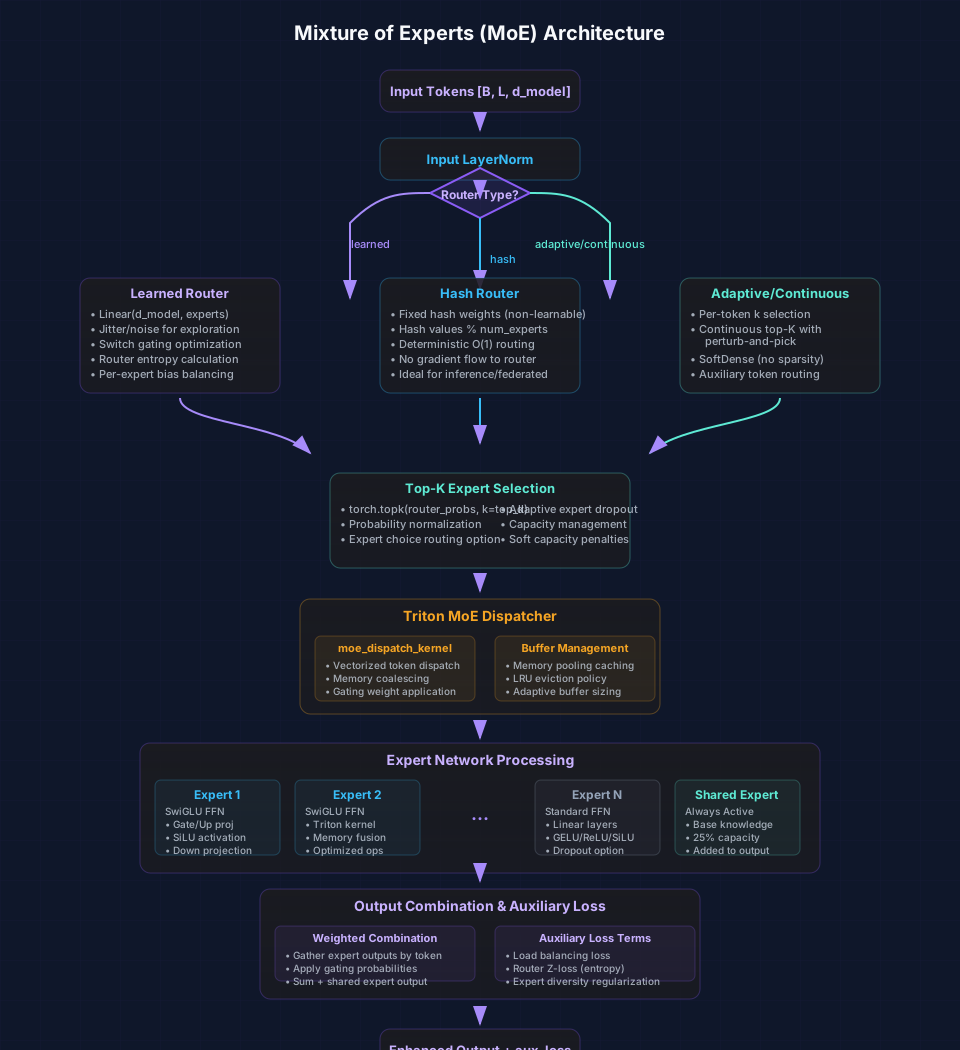
How MoE is enabled
from foreblocks import TransformerEncoder, TransformerDecoder

encoder = TransformerEncoder(
    input_size=8,
    d_model=256,
    n_heads=8,
    num_layers=4,
    moe_experts=8,
    moe_top_k=2,
)

decoder = TransformerDecoder(
    input_size=1,
    output_size=1,
    d_model=256,
    n_heads=8,
    num_layers=4,
    moe_experts=8,
    moe_top_k=2,
)
Recommended presets
Stable baseline
encoder = TransformerEncoder(
    input_size=8,
    d_model=256,
    n_heads=8,
    num_layers=4,
    moe_experts=8,
    moe_top_k=2,
    moe_aux_weight=1.0,
    moe_options={"num_shared": 1, "router_type": "noisy_topk", "routing_mode": "token_choice", "z_loss_weight": 1e-3},
)
Higher-capacity experimental setup
encoder = TransformerEncoder(
    input_size=8,
    d_model=384,
    n_heads=8,
    num_layers=6,
    moe_experts=16,
    moe_top_k=2,
    gradient_checkpointing=True,
    moe_options={"num_shared": 2, "routing_mode": "expert_choice", "moe_capacity_factor": 1.5, "z_loss_weight": 1e-3},
)
Advanced features in the current implementation
Router types
ForeBlocks provides several router implementations in foreblocks.nn.moe.routers:
NoisyTopKRouter(default, recommended)StraightThroughTopKRouterContinuousTopKRouterHashTopKRouterAdaptiveNoisyTopKRouterSoftDenseRouterAuxiliaryTokenRouterLinearRouter
See the Advanced MoE Guide for detailed router configuration.
Adaptive top-k
adaptive_noisy_topk can vary the effective number of experts selected per token.
This path also tracks per-token k statistics and supports a REINFORCE-style adaptive-k loss internally.
Hash routers
hash_topk and multi_hash_topk are available when you want routing diversity without a standard learned dense router over all experts.
Grouped expert kernel path
The implementation uses grouped expert kernels when available. Packed expert weights are read directly on every forward, including evaluation; no step callback or inference cache refresh is required. Top-k routing uses PyTorch (optionally compiled); a separate fused top-k kernel is not currently shipped.
You usually do not need to tune these first. They are lower-level performance details rather than primary modeling controls.
MTP heads inside MoE
The MoE block supports optional multi-token-prediction heads:
mtp_num_headsmtp_loss_weight
This is an advanced decoder-side path and should be treated as research functionality, not a default production setting.
Integration with ForecastingModel
See the Custom Blocks Guide for wiring models into ForecastingModel.
Routing correctness and checkpoint compatibility
Top-1 uses the selected probability from the full expert softmax so task loss can train the router. Top-k with k > 1 normalizes over selected experts. Adaptive routing uses the same rule for tokens assigned one expert.
Load-balancing biases are selection-only buffers rather than trainable parameters. Model checkpoint keys remain compatible, but optimizer checkpoints created when these biases were parameters require rebuilding the optimizer. moe_router_bias_min_usage remains accepted for compatibility and no longer limits which imbalances are corrected.
Adaptive-K policy losses minimize negative advantage times log probability, so positive rewards increase the probability of the sampled choice.